5 Biggest Stock Market Crashes in History and What We Learned
Have you ever found yourself wondering about the world's most notorious financial downturns? Have you ever thought about the aftermaths and how those monumental moments changed our world?
It's daunting to consider the far-reaching consequences of a stock market crash. But here's the silver lining: By understanding these past events, you'll be better prepared for the future.
Dive in with us as we delve into the “5 Biggest Stock Market Crashes in History and What We Learned”. Let this be your guide to understanding, learning, and, most importantly, staying ahead.
The Key Moments That Defined Financial History
A stock market crash isn't just a dip in numbers; it's a reflection of global sentiments, policies, and decisions made (or not made). By understanding the past, you equip yourself with insights to navigate the future.
1. The Wall Street Crash of 1929
Often cited as the most infamous crash in history, it began on October 24, known as Black Thursday, and culminated on Black Tuesday, October 29, 1929. Billions of dollars were wiped off the stock market, leading to the Great Depression.
Causes:
● Many bought stocks on margin, meaning they paid a fraction of a stock's real value, borrowing the rest.
● Inadequate regulations and policies were in place.
● There were differences between the rich and the poor, and industrial production was declining.
Consequences:
Widespread panic and withdrawal from banks led many to bankruptcy.
● At its peak, the unemployment rate was nearly 25%.
● The Depression affected countries worldwide, especially those dependent on the U.S.
Lessons Learnt:
● The importance of stringent regulations.
● The dangers of over-speculation and heavy reliance on credit.
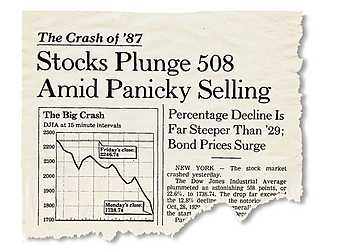
2. The 1987 Black Monday Crash
On October 19, 1987, the Dow Jones plummeted 22.6% in a single day. This crash was shocking due to its speed and the scale of the drop.
Causes:
● New computer programs made large stock trades faster, accelerating losses.
● The U.S. had high-interest rates, which drove investors to bonds instead of stocks.
● Issues between the U.S. and Germany over monetary policies.
Consequences:
● Stock markets from Hong Kong to Europe were affected.
● Post this crash, stock exchanges implemented circuit breakers to prevent panic selling.
Lessons Learnt:
● The need for improved trading curbs.
● The importance of global cooperation in monetary and economic matters.
3. The Asian Financial Crisis of 1997
This crash began in Thailand when the Thai baht collapsed after the government decided not to peg it to the U.S. dollar. The crisis spread like wildfire through Southeast Asia.
Causes:
● Countries borrowed heavily, assuming constant growth.
● Rapid withdrawal of money by foreign investors.
● Inadequate foreign reserves to maintain fixed exchange rates.
Consequences:
● Many Asian currencies devalued.
● Equity markets and governments in the region were severely impacted.
● Many countries had to seek the IMF's help, leading to strict fiscal and monetary requirements.
Lessons Learnt:
● The importance of maintaining sufficient foreign reserves.
● Need for transparency in financial operations.
4. The Dot-com Bubble of 2000
The late 1990s saw a rush towards internet-based companies. But by 2000, the NASDAQ composite, rich in tech stocks, crashed from over 5,000 to around 1,000 by 2002.
Causes:
● Internet companies, many without profits, saw sky-high stock prices.
● Excessive speculation on the growth of the internet.
● Venture capital leads to too many unfeasible business models.
Consequences:
● Massive losses for investors.
● Many dot-com startups went bankrupt.
● Mild recession in the early 2000s.
Lessons Learnt:
● The necessity of sound business fundamentals.
● Avoiding herd mentality in investments.
5. The 2008 Global Financial Crisis
Triggered by a burst in the housing bubble and propagated by complex financial derivatives like mortgage-backed securities, it was the worst financial crisis since the Great Depression.
Causes:
● Loose lending standards: Banks approved high-risk mortgage loans.
● Financial products like CDOs (Collateralized Debt Obligations) masked risks.
● High consumer debt.
Consequences:
● Major financial institutions like Lehman Brothers collapsed.
● Global markets faced prolonged downturns.
● Governments worldwide had to bail out banks to prevent further collapse.
Lessons Learnt:
● The importance of stringent oversight on financial institutions.
● The risks of complex, poorly understood financial products.
Conclusion
The ebbs and flows of the stock market, as demonstrated by these crashes, shape our global economic landscape. While they signify financial turmoil and hardships, they also offer us invaluable lessons.
By understanding these historic downturns, we not only equip ourselves with the knowledge to make informed decisions but also stand a chance to prevent history from repeating itself.
Stay informed, stay ahead, and remember – knowledge is your most powerful asset.